

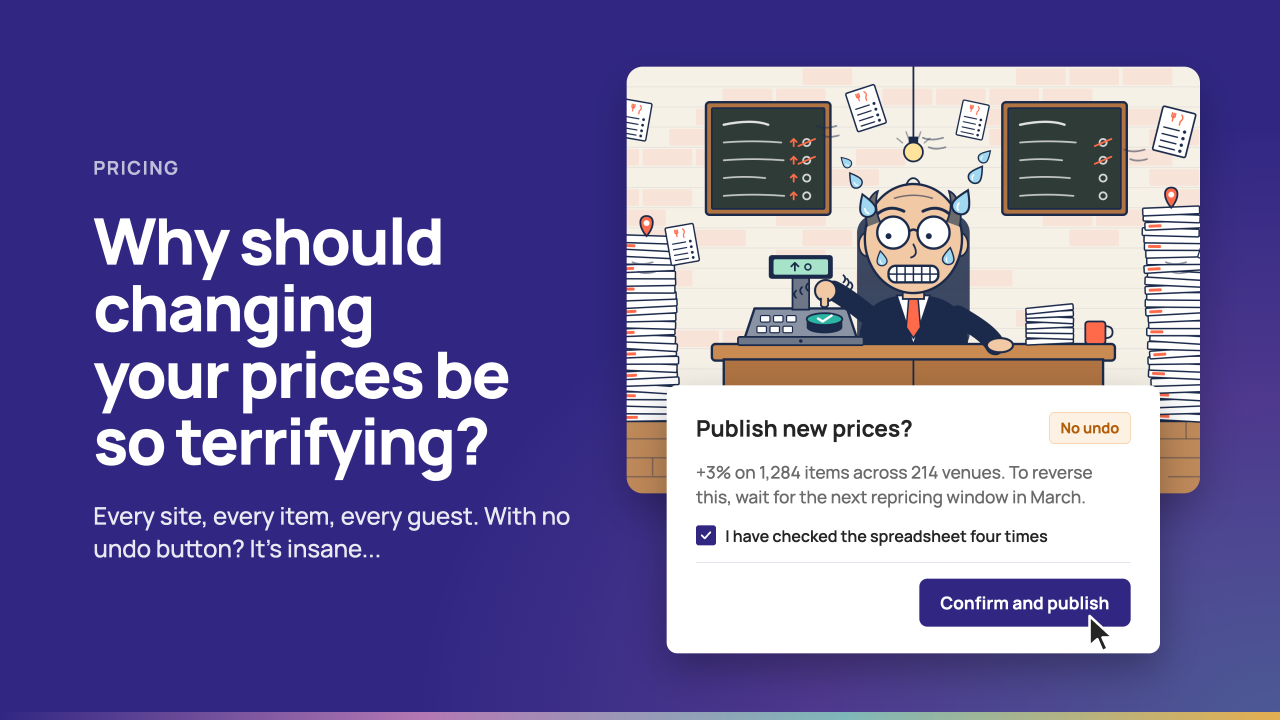
Think back to the last big pricing or menu call that didn’t work out. A small miss that hurt trade: item repositioned at the wrong price point, a price band that slowed down a bestseller, an increase that tipped a loyal segment of guests somewhere else. You probably knew within a few weeks. So why did it take weeks or months to unwind?
The honest answer is that your systems are not designed to allow for pricing agility. Once a change is made, it’s very difficult to undo. Once a price change went live across the estate, getting back to where you started meant another full repricing exercise, another round of sign off, another wait for the next scheduled update window.
The problem wasn’t the decision. It was that once made, it was almost as hard to undo as it was to make in the first place. It’s almost as if it’s taken for granted, and it’s just the way it is. That’s worth reconsidering.
For years, the standard response to cost pressure has been a blanket price rise of 2% or 3%, applied estate-wide once or twice a year. It has worked well enough that nobody questioned the mechanism, only the size of the number. But guests have a ceiling, and that ceiling is closer than it used to be. Pull the same lever again and the next rise costs revenue outright, because enough guests simply order less or go elsewhere to cancel the gain.
Most operators can feel this coming, even if they can’t quantify it precisely. And yet the response to that discomfort is usually to pull the lever anyway, because it’s the only lever most systems make easy to pull.
It is worth trying to look at this through a different lens. A blanket price rise, decided in a single meeting twice a year, is applied to every site, every item and every guest at once, with no control group and no way to learn what actually happened before the next change is made. It is an untested bet placed against the entire P&L, and it is treated as the safe, conservative choice simply because it is familiar.
Compare that with testing a change on a handful of sites, watching what happens against a matched control group and being able to revert within days if it doesn’t work. That is the cautious option. The blanket rise only looks safer because reverting it was never built into how most pricing systems work.
Operators don’t need to become bolder about pricing decisions. What they need is the infrastructure to make a change and unmake it just as quickly if the evidence says to, and the intelligence to model that change properly before it goes live in the first place. Better pricing intelligence, modelled against your own data before a change ships, means fewer decisions made on gut instinct and fewer mistakes that need undoing at all.
It is a question of whether your systems let you revert a price at a named group of venues within a day, and whether they let you see the likely impact before you commit to it, rather than waiting for the next scheduled repricing cycle to find out either way.
Once reversibility is available, the whole equation changes. A price change stops being a single high-stakes bet and becomes something closer to an experiment you can walk back if required. The operators who feel most comfortable with pricing right now are the ones who have quietly removed the biggest risk from the equation altogether: the risk of being stuck.
That shift also opens up something bigger than damage control. If pricing decisions no longer have to be irreversible, they no longer have to be blunt either. There is a meaningful amount of revenue sitting in the gap between a rise applied evenly across a menu and a rise applied precisely where guests will actually tolerate it.
This article was written by Nick Liddle, Chief Customer Officer at Openr, The Menu & Pricing OS for multi-site hospitality. It was originally shared in Propel Info‘s Friday Opinion Newsletter.